Following government announcements, 22.48 m2 is due to temporarily close its doors to the public until December 2, but is looking forward to seeing you online on Facebook / Twitter / Instagram. To be informed of exclusive content, subscribe to our newsletter. ❤️


affiche : Chani Pouzet

exhibition view

e.x.u.v.i.e.s (detail), 2026, found objects (jacket, beads and zip), digital prints on polyester fabric, wadding, quilting, variable dimensions

exhibition view

Exhibition view

e.x.u.v.i.e.s , 2026 Found objects (jacket, beads and zipper), digital prints on polyester fabbric, batting, quilting Varying sizes Unique

Exhibition view

e.x.u.v.i.e.s , 2026 Found objects (jacket, beads and zipper), digital prints on polyester fabbric, batting, quilting Varying sizes Unique

e.x.u.v.i.e.s , 2026 Found objects (jacket, beads and zipper), digital prints on polyester fabbric, batting, quilting Varying sizes Unique

e.x.u.v.i.e.s (detail), 2026 Found objects (jacket, beads and zipper), digital prints on polyester fabbric, batting, quilting Varying sizes Unique

e.x.u.v.i.e.s , 2026 Found objects (jacket, beads and zipper), digital prints on polyester fabbric, batting, quilting Varying sizes Unique

e.x.u.v.i.e.s (detail), 2026 Found objects (jacket, beads and zipper), digital prints on polyester fabbric, batting, quilting Varying sizes Unique

e.x.u.v.i.e.s (detail), 2026 Found objects (jacket, beads and zipper), digital prints on polyester fabbric, batting, quilting Varying sizes Unique

e.x.u.v.i.e.s (detail), 2026 Found objects (jacket, beads and zipper), digital prints on polyester fabbric, batting, quilting Varying sizes Unique

e.x.u.v.i.e.s , 2026 Found objects (jacket, beads and zipper), digital prints on polyester fabbric, batting, quilting Varying sizes Unique
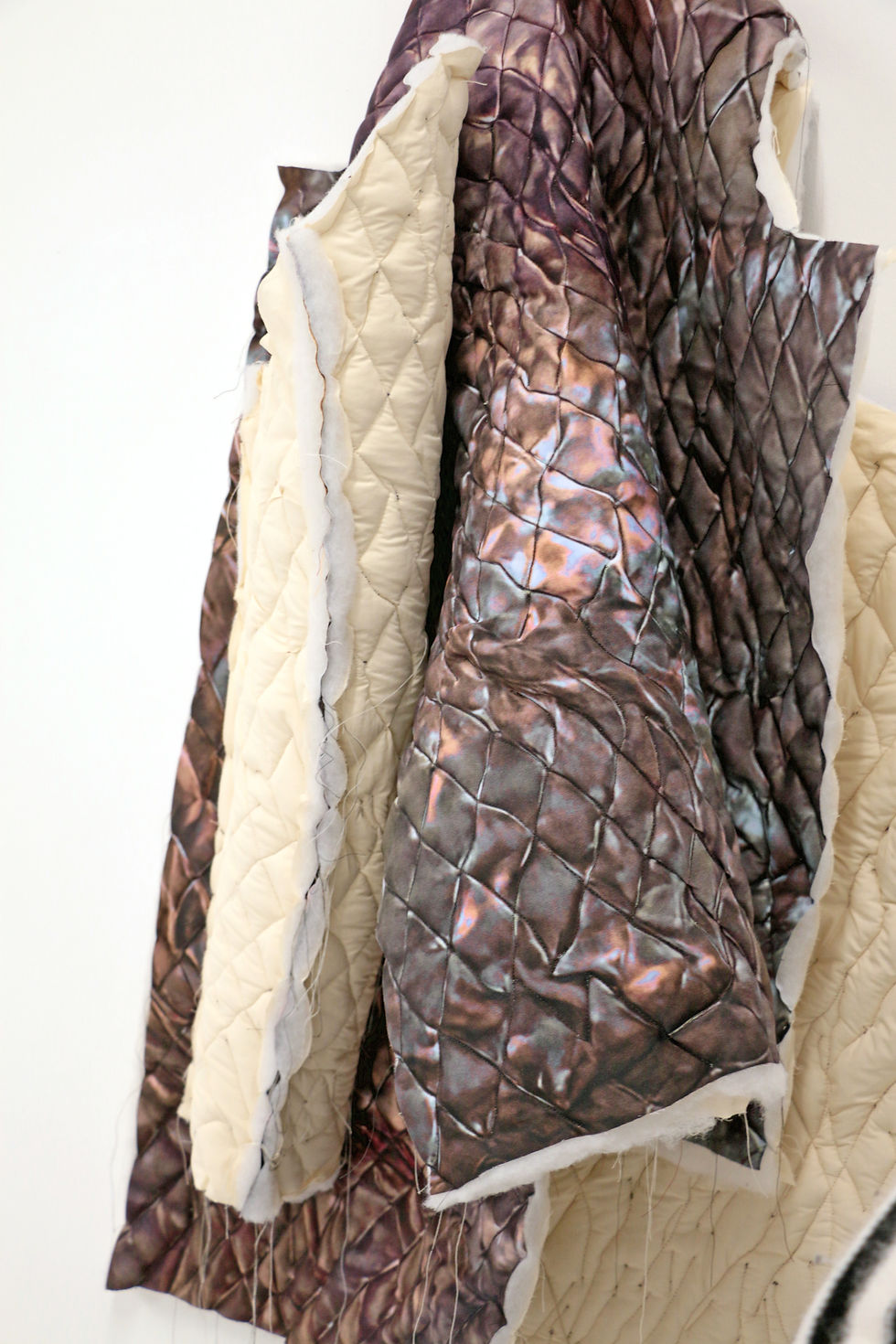
e.x.u.v.i.e.s (detail), 2026 Found objects (jacket, beads and zipper), digital prints on polyester fabbric, batting, quilting Varying sizes Unique

e.x.u.v.i.e.s (detail), 2026 Found objects (jacket, beads and zipper), digital prints on polyester fabbric, batting, quilting Varying sizes Unique

e.x.u.v.i.e.s (detail), 2026 Found objects (jacket, beads and zipper), digital prints on polyester fabbric, batting, quilting Varying sizes Unique


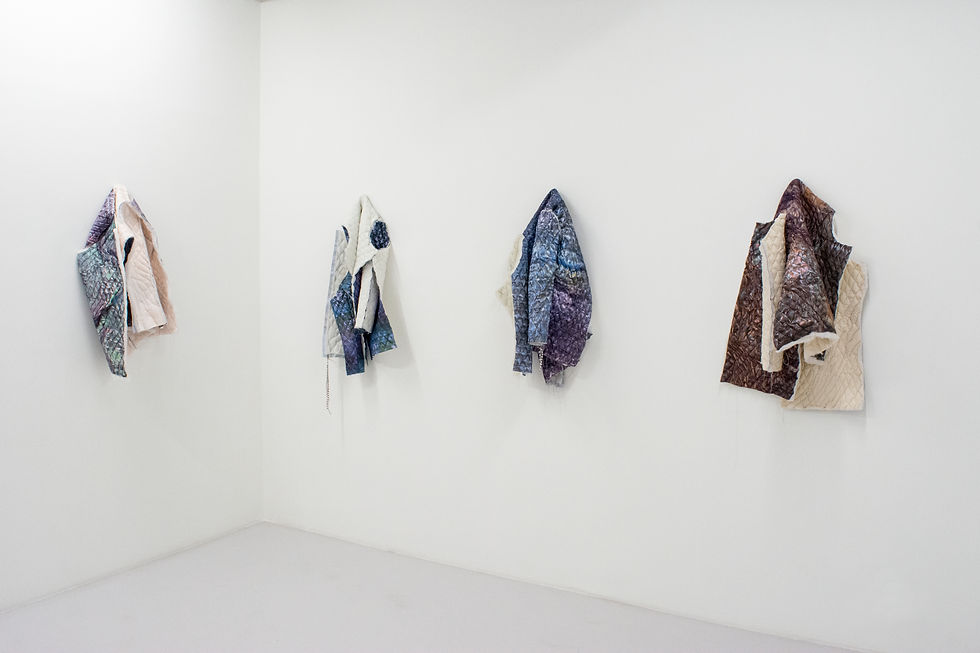

Exhibition view

Fairing (translation 26.02), 2026 Digital prints on polyester fabric, quilting 64.5 x 63 inches Edition of 3+1AP

Fairing (translation 26.02) (detail), 2026 Digital prints on polyester fabric, quilting 64.5 x 63 inches Edition of 3+1AP

Fairing (translation 26.02) (detail), 2026 Digital prints on polyester fabric, quilting 64.5 x 63 inches Edition of 3+1AP

Fairing (translation 26.02) (detail), 2026 Digital prints on polyester fabric, quilting 64.5 x 63 inches Edition of 3+1AP

Fairing (translation 26.02), 2026 Digital prints on polyester fabric, quilting 64.5 x 63 inches Edition of 3+1AP
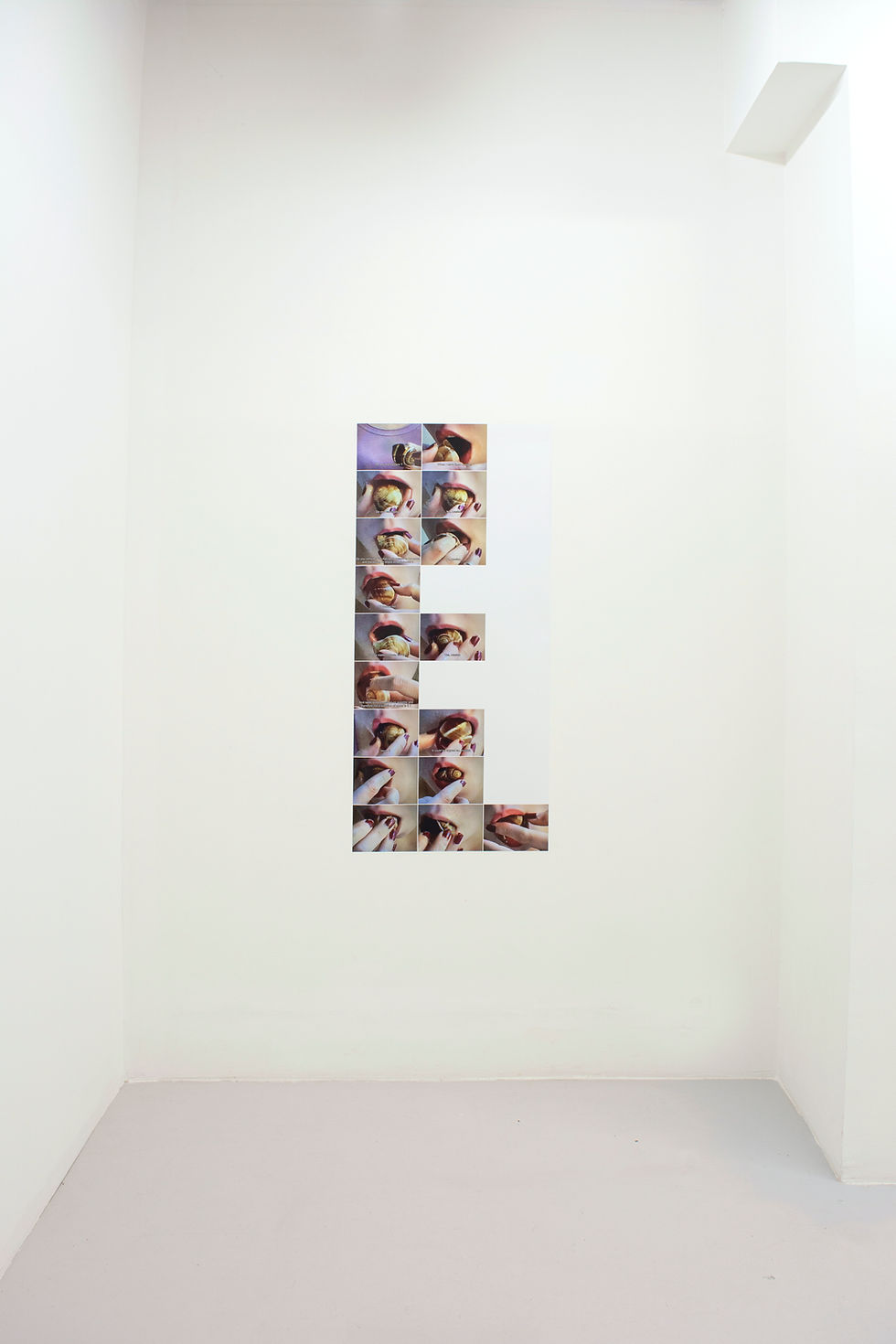
Exhibition view

Do you consider the eating of oysters to be moral and the eating of snails to be immoral ?, 2026 Dialogue extract from the movie Spartacus (1960) and screen photographs 23.8 x 53.8 inches Edition of 10

Exhibition view

Do you consider the eating of oysters to be moral and the eating of snails to be immoral ?, 2026 Dialogue extract from the movie Spartacus (1960) and screen photographs 23.8 x 53.8 inches Edition of 10
#92
Caroline Delieutraz, Victoire Marion-Monéger
e.x.u.v.i.e.s
duo show
14/02 - 11/04/2026
at the Studio
If I can’t go beyond it, I play.
— Howardena Pindell
The dots placed between the letters of the word exuviae—a term referring to the skin shed by insects during molting—echo the countless stitching points that, by the thousands, retrace and reinforce the structural lines of the works composing this exhibition. These points resemble the traces of repeated gestures from a protocol imagined and practiced jointly by Caroline Delieutraz and Victoire Marion-Monéger. Running along the regular edges of these various jackets, the stitches quilt them, structure them, turn them into sculptures, shift them from the second to the third dimension, and thus, perhaps, from exuviae to life.
Starting from a standard garment sourced in a thrift store—a purple quilted jacket, a piece that has traversed history and, through constant circulation, has become an archetype of fast fashion—Caroline Delieutraz and Victoire Marion-Monéger join forces in this exhibition to develop a body of work addressing the modes of production and distribution specific to both artworks and clothing. Their collaborative method speaks of partnership as a site of displacement and raises the question of what an encounter does to a practice. A shift toward a series of pieces that reveal their interiority, irregularities, and imperfections for Caroline Delieutraz, whose artistic practice is rooted in post-internet aesthetics. A shift toward the garment as a playground for image-making for Victoire Marion-Monéger, whose textile work unfolds through performance and video. The notions of process and seriality expand through their exchange, taking on new forms here.
The specific production of this exhibition, which begins with this jacket, resulted in a set of variations around quilting—a technique that remains relatively under-conceptualized and undocumented in France, better known in English-speaking countries as quilting. The jacket’s original quilted grid forms a repeated diamond pattern generated by intersecting lines. The two artists devised a working protocol consisting of photographing the jacket and its initial quilting pattern, then involving an AI—aptly named Firefly—that “digests” the photographed motif. The image is reworked, reprinted, and finally sewn to recreate the quilting, and this process is repeated several times. The interplay between dimensions and meanings—from the 2D photograph to the 3D textile, between the flat and the padded surface of quilting, between the printed line and the stitched line—produces a set of different, evolving jackets, both digested and generated by one another, with the presence of a third player and co-author: Firefly.
These human exuviae strongly evoke the tactile sense through their fluffy quality—soft, downy—and their sandwich-like thickness of layered fabrics. The pearl pendants attached to the hems of the jackets are a singular detail that catches the eye, doubling the pieces’ shine and suggesting the faint sound of their clinking. Several senses are thus simultaneously stimulated and evoked in this series, foremost touch and sight. The idea of the jacket as a soft outer envelope, like a molt shed in the process of growth, works by analogy with the animal shell—fascinating, protective, sometimes iridescent. The colorimetric and geometric dimensions of the biological and animal world—visible, for instance, in camouflage patterns and the infinite vibrations of insect carapaces and mollusk shells—strongly inform the series. The AI bends and distorts the photographed material, producing an image both very close to and very distant from the idea of nature, almost parabolic. Sewing and quilting slant the material, following the lines of the printed motifs. The various processes of textile transformation thus generate a sense of strangeness, emerging from perceptions multiply interpreted by photography, by the human hand and eye, and by AI.
From beetles to water lilies, the inspiration and repetition of a motif introduce questions of vulnerability and “vulnerability in dispersion” (Seth Price, Dispersion, 2002). The jacket prototype—an envelope that could equally be a shell or a carapace—protects its wearer while also charging its appearance with meaning. It creates an intermediate space between interiority and exteriority. The experimental gallery space, with its interior, intimate, almost domestic character, echoes this intermediate position of surface and skin. If “repetition modulates an exit from oneself” (Deleuze on Monet’s Water Lilies), then the work in this series enacts a progressive, almost decomposed and protocol-driven unfolding in major stages. At once “domestic convenience” and “conceptual tool” (Sarat Maharaj), quilting here becomes a collaborative and deceptively mimetic visual and material playground.
The resonances between this series and the individual projects by Caroline Delieutraz and Victoire Marion-Monéger presented in the exhibition are numerous; seriality, repetition, numbers, and the passage from the material to the symbolic and from the symbolic back to the material pave the way.
In her series of works centered on the 119 Pandinus dictator scorpions seized by French customs during their illegal transit between Cameroon and the United States in 2015, Caroline Delieutraz explores—through various media including a series of photographs, a ready-made sculpture, a video, and a scenography—the material, cultural, and symbolic circulation of animals within capitalist and postcolonial regimes. The piece from this series presented in the exhibition reworks, retrospectively and in textile form, the fairing of a T-Max scooter—another globally circulated consumer object—displayed frontally on the wall and evoking a dismembered shell. An exhibition photograph by Aurélien Mole served as a step in translating one form into another and one medium into another. This passage—from object to image, then to textile—organizes a series of displacements. The work functions as its own quilted surface, a space of overlays and rebounds where forms metamorphose according to the digital, material, and imaginary flows that traverse them.
For her part, Victoire Marion-Monéger presents in the work Do you consider the eating of oysters to be moral and the eating of snails to be immoral? a poster bringing together 17 photographs of a screen playing the film of a performance in which she is seen slowly and sensually eating the flesh of 12 snails along with their shells. The English subtitles added to the stills borrow dialogue from Stanley Kubrick’s Spartacus (1960). The work is thus repositioned within a critical framework, evoking through language the power relations between a decadent Roman and Spartacus, the slave who leads a revolt. The piece becomes a parabolic commentary on power relations embedded in food, through the representation of a body devouring others and the artificial moral hierarchy between oysters and snails. Echoing e.x.u.v.i.e.s, this work reflects on the protective function of the shell as both biological element and symbolic and social marker of taste and dining, traversing and citing multiple eras and artistic forms.
In e.x.u.v.i.e.s, the sewing pattern at the origin of several pieces thus becomes a collaborative exoskeleton upon which a set of unexpected, reiterated, and structuring motifs develop and repeat. The exhibition tests the idea of distribution as a “reading circuit,” and perhaps also, in its own way, production as a “phase of excretion within a process of appropriation” (Seth Price, Dispersion, 2002). The two artists approach it instead as a series of “molts”—ways of moving toward a symbolic understanding of the world through the detour of the animal, its representations, its imitations, and its impossible standardization in a world of constant global circulation. The works thus articulate and create a necessary space of hybridity. Their arrangement proposes to recode our representations in order to better subvert logics of predation, in a warm and comforting recommencement.
Margot Nguyen